Interesting...
Michelin has released a free sustainable mobility book - Driving in the Future It looks very thorough. Of course Michelin gets to sell tires for any vehicle that uses them, regardless the propulsion method. I guess we can save our skepticism of their motives for when they offer their opinions of mass transit solutions that do not use rubber tires...
Thursday, June 10, 2010
A Tire Company Takes Driving's Impact on the Environment Seriously
Labels:
ethics,
leadership,
risk,
science,
service
Wednesday, June 9, 2010
2012
Apparently 2012 catastrophe hype is scaring young children in some communities...
As a thoughtful counter-point this well-written article is far more interesting that the alleged imminent event itself. By the way, when did 2012 stop being a silly notion and become a pseudoscience hoax, complete with its own conspiracy theory?
Labels:
critical thinking,
ethics,
history,
science,
skepticism
An American Deer Hunter In Africa, Part II
There are things the hunting magazine articles rarely mention and the classic books on the subject only offer up to careful scrutiny...
Part II: Your Kit
Make certain all of your equipment is completely silent. I had a creaking left boot tongue that was quieter if I tied it just so. The other boot was silent. Perhaps I’d never been anywhere quiet enough to notice before. Your rifle’s sling swivels probably clatter a bit did --like mine-- unless you have already silenced them with bits of cloth tape. If you use your host’s masking tape for this chore you’ll appear to be very dedicated hunter who didn’t sort things out before hand, or who forget to pack a small role of duct tape --Ol’ Indispensable-- along in his toilet kit. Cordura --apparently outdoor equipment manufacturer’s favorite fabric-- is extremely noisy in the bush. Shorts, pants, and shirts made with "hard" cotton cloth worked well for me. Velcro fasteners on pockets are common, and noisy as well. Buttons are quieter, but the thornbush will sometimes unbutton them for you. The leather holster in which I carried my Contender pistol creaked every minute I wore it. It even creaked when the my only motion was breathing. I gave it up --the holster, not breathing-- at lunch on the third day.
Dress for the weather. You’ll probably be hunting during the African winter. There isn’t much chance of snow, but it can be chilly in the mornings. Depending on the time of day and the whims of nature you could need rain gear, a coat, balaclava, sun hat, gloves, long sleeve shirt, long pants, shorts, short sleeved shirt, boots, or low shoes.
Short pants and short-sleeved shirts are quieter in the bush, but only because your skin makes less noise when snagged by thorns. I looked liked second place in a cat fight by the end of the first day, but as our host, Schalk van Heerden, says, "Your skin will grow back, but you may not see that Kudu again this week."
The bushveld will untie your bootlaces and then shred them for you if you let it. If you wear socks or laced boots with your shorts get yourself some gaiters to keep your boot laces tied and your socks free from all sorts of very persistent "stickers." Of course, most gaiters are made of Cordura, so you’ll probably need to fabricate your own of some quieter fabric. I suppose the well-heeled, lazy man could always bring enough socks to throw his bramble-laden pair away each evening. The rest of us will have to pick the burrs from our socks by the fire each evening.
Spare no expense on your footwear. If you’re going to "walk and stalk" (think "stillhunting") you’re going to be on your feet at least eight hours a day. Buy the very best boots or walking shoes you can afford. My Gore-tex lined Danner’s have a lot more character now then they did before the expedition, but everything but the laces survived in great condition. Get the best socks you can find, even if you plan to throw them away. Thorlos worked very well, keeping my feet warm but dry under all conditions, in temperatures that varied from the low 40’s to the upper 80’s Fahrenheit. Unless you are hunting in rocky, uneven terrain, heavy boots with lugged soles may be noisier than you want. A low rise leather shoe with a soft sole might allow you to feel a dry twig beneath your feet before you break it at the closing moments of a very clever sneak. It may be just me, but I’d swear dry twigs in Africa snap much more loudly than those in America.
Consider wearing a hat with a large enough brim that you don’t have to wear sunglasses. My fancy "city-boy" clip-on’s had a brown tint which is precisely the wrong color for hunting clever brown animals in the tall brown grass. Gray or green sunglasses are probably much better, but you’ll note that your tracker never wears them and your PH rarely does.
Wear lip balm, and sunscreen on at least your neck, ears, and nose. Wear rub-on bug repellent on at least your legs to keep the ticks away. African ticks are bigger and uglier than our ticks. Our tracker used a panga to kill one he found crawling on him. I packed along spray-on DEET, just in case mosquitoes ("the deadliest animal in Africa") were a problem. They weren’t. I did, however, encounter a species of fly in Africa that will deliberately crawl up your nose if you don’t stop it.
Bring as small and light a good camera as you can. The larger or heavier the camera the more likely it is to get left behind, as mine did when I doffed my Cordura buttpack on the second day. Things sometimes change in a hurry in Africa and you’ll miss some great photos unless your camera is in your pocket. You may spend the rest of your life describing what its like to be in the middle of a Red Hartebeest stampede (instead of being able to show your family and friends photographs of what it looks like) simply because your camera was only as far away as the front seat of the Land Cruiser.
Bring some light, compact, and easy to use binoculars. Even in the bush binoc’s come in handy every couple minutes. No, that is not what your rifle scope is for. My 10x Vivitar’s offered perhaps just a bit too much magnification, but they served well although --no, perhaps because-- they were not quite pocket sized. They were light enough to wear all day without causing a strain on the back of my neck and small enough to pop down the front of my shirt if the action called for crawling or if the sneak would tolerate no chance of my binoculars clattering into my rifle.
Carry a decent knife of moderate length. It is customary to finish not quite expired game with a knife blade slipped between the between the base of the skull and the first vertebra. Your PH will carry such a blade, but your tracker may not. The ranch hands are very polite when you offer them your Leatherman "folding toolbox," but it’s pretty clear they appreciate the pliers a lot more than they do the knife blade. I think I’ll carry a Cold Steel Master Hunter next time. It’ll be sharper than anything the help is used to and will make a nice gift to some especially hardworking staff member when the safari is over. You won’t be doing any skinning, but you might find yourself loaning a good, sharp blade to the staff to keep the work moving forward on the larger trophies late at night.
Make certain all of your equipment is completely silent. I had a creaking left boot tongue that was quieter if I tied it just so. The other boot was silent. Perhaps I’d never been anywhere quiet enough to notice before. Your rifle’s sling swivels probably clatter a bit did --like mine-- unless you have already silenced them with bits of cloth tape. If you use your host’s masking tape for this chore you’ll appear to be very dedicated hunter who didn’t sort things out before hand, or who forget to pack a small role of duct tape --Ol’ Indispensable-- along in his toilet kit. Cordura --apparently outdoor equipment manufacturer’s favorite fabric-- is extremely noisy in the bush. Shorts, pants, and shirts made with "hard" cotton cloth worked well for me. Velcro fasteners on pockets are common, and noisy as well. Buttons are quieter, but the thornbush will sometimes unbutton them for you. The leather holster in which I carried my Contender pistol creaked every minute I wore it. It even creaked when the my only motion was breathing. I gave it up --the holster, not breathing-- at lunch on the third day.
Dress for the weather. You’ll probably be hunting during the African winter. There isn’t much chance of snow, but it can be chilly in the mornings. Depending on the time of day and the whims of nature you could need rain gear, a coat, balaclava, sun hat, gloves, long sleeve shirt, long pants, shorts, short sleeved shirt, boots, or low shoes.
Short pants and short-sleeved shirts are quieter in the bush, but only because your skin makes less noise when snagged by thorns. I looked liked second place in a cat fight by the end of the first day, but as our host, Schalk van Heerden, says, "Your skin will grow back, but you may not see that Kudu again this week."
The bushveld will untie your bootlaces and then shred them for you if you let it. If you wear socks or laced boots with your shorts get yourself some gaiters to keep your boot laces tied and your socks free from all sorts of very persistent "stickers." Of course, most gaiters are made of Cordura, so you’ll probably need to fabricate your own of some quieter fabric. I suppose the well-heeled, lazy man could always bring enough socks to throw his bramble-laden pair away each evening. The rest of us will have to pick the burrs from our socks by the fire each evening.
Spare no expense on your footwear. If you’re going to "walk and stalk" (think "stillhunting") you’re going to be on your feet at least eight hours a day. Buy the very best boots or walking shoes you can afford. My Gore-tex lined Danner’s have a lot more character now then they did before the expedition, but everything but the laces survived in great condition. Get the best socks you can find, even if you plan to throw them away. Thorlos worked very well, keeping my feet warm but dry under all conditions, in temperatures that varied from the low 40’s to the upper 80’s Fahrenheit. Unless you are hunting in rocky, uneven terrain, heavy boots with lugged soles may be noisier than you want. A low rise leather shoe with a soft sole might allow you to feel a dry twig beneath your feet before you break it at the closing moments of a very clever sneak. It may be just me, but I’d swear dry twigs in Africa snap much more loudly than those in America.
Consider wearing a hat with a large enough brim that you don’t have to wear sunglasses. My fancy "city-boy" clip-on’s had a brown tint which is precisely the wrong color for hunting clever brown animals in the tall brown grass. Gray or green sunglasses are probably much better, but you’ll note that your tracker never wears them and your PH rarely does.
Wear lip balm, and sunscreen on at least your neck, ears, and nose. Wear rub-on bug repellent on at least your legs to keep the ticks away. African ticks are bigger and uglier than our ticks. Our tracker used a panga to kill one he found crawling on him. I packed along spray-on DEET, just in case mosquitoes ("the deadliest animal in Africa") were a problem. They weren’t. I did, however, encounter a species of fly in Africa that will deliberately crawl up your nose if you don’t stop it.
Bring as small and light a good camera as you can. The larger or heavier the camera the more likely it is to get left behind, as mine did when I doffed my Cordura buttpack on the second day. Things sometimes change in a hurry in Africa and you’ll miss some great photos unless your camera is in your pocket. You may spend the rest of your life describing what its like to be in the middle of a Red Hartebeest stampede (instead of being able to show your family and friends photographs of what it looks like) simply because your camera was only as far away as the front seat of the Land Cruiser.
Bring some light, compact, and easy to use binoculars. Even in the bush binoc’s come in handy every couple minutes. No, that is not what your rifle scope is for. My 10x Vivitar’s offered perhaps just a bit too much magnification, but they served well although --no, perhaps because-- they were not quite pocket sized. They were light enough to wear all day without causing a strain on the back of my neck and small enough to pop down the front of my shirt if the action called for crawling or if the sneak would tolerate no chance of my binoculars clattering into my rifle.
Carry a decent knife of moderate length. It is customary to finish not quite expired game with a knife blade slipped between the between the base of the skull and the first vertebra. Your PH will carry such a blade, but your tracker may not. The ranch hands are very polite when you offer them your Leatherman "folding toolbox," but it’s pretty clear they appreciate the pliers a lot more than they do the knife blade. I think I’ll carry a Cold Steel Master Hunter next time. It’ll be sharper than anything the help is used to and will make a nice gift to some especially hardworking staff member when the safari is over. You won’t be doing any skinning, but you might find yourself loaning a good, sharp blade to the staff to keep the work moving forward on the larger trophies late at night.
The PolitiFact Truth-o-Meter
This seems like a really good idea...
Haven't had time to screen the PolitiFact Truth-o-Meter for bias but on first glance they seem happy to skewer anyone bending the truth and credit even the most unlikely persons with telling the truth sometimes.
Labels:
ethics,
law,
leadership,
politics,
service,
skepticism
Tuesday, June 8, 2010
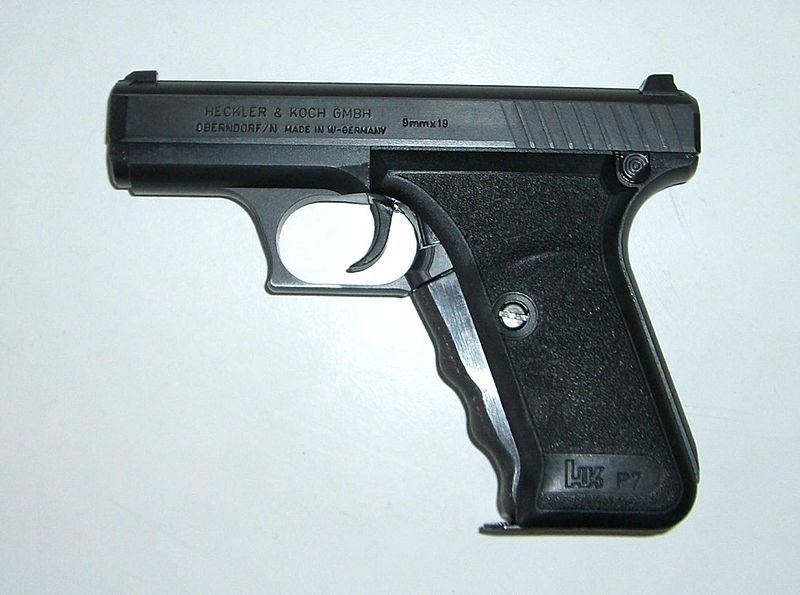
H&K P7 PSP - A Blast From The Past
The Heckler & Koch P7 Polizei Selbstlade Pistole (PSP)...
Image from Wikimedia Commons
The P7 PSP is one of several pistols developed in response to a functional specification let by the German state police in the 1970s as they sought to modernize their equipment in the wake of the Munich Massacre. Several manufacturers produced pistols that met the spec in different ways. German police organizations were free to choose from the results. Instantly ready with no switches, instantly safe when dropped, totally reliable, and possessing some of the best ergonomics of any pistol every made, the H&K P7 met the sensible specification with a collection of clever design elements.
I took a P7 PSP on my first trip to Jeff Cooper's Gunsite for API-250 Basic Pistol in 1986. I got ribbed for bringing a staple gun to a shooting school. I got ribbed - "Hey, where's the rest of your holster?" - for carrying it in in a very minimal Rogers holster; a hand-signed early laminate job not much larger than a pager, a surprisingly secure speed rig, of which I've never seen another example. The Old Man said, "That's a fine pistol; too bad it's chambered for the wrong cartridge."
The P7 takes much less force to hold at full cock than it does to cock it. Anyone who can't cock a P7 is likely going to have trouble racking a slide or squeezing off a double action trigger. It is not noisy when cocking but it does make a distinct "clack!" when you release the cocker (unless you have the time, presence of mine, and fine motor skills under stress to do the silent decocking trick).
My P7 is utterly reliable. It never once failed to feed, fire, extract, or eject all week, unlike most of the 1911's I've shot or seen shot. During the failure drills rangemaster Louis Awerbuck told me "the P7 doesn't stop, but you need to play along." In my direct experience the only other pistol that comes close to this level of reliability are the various Glocks.
It's fast. I wasn't often the first from the holster, but I was always the first one done. It was Wednesday before I realized I was shooting "hammers" back to 10 meters. The magazine change is faster than it looks as it does not share the usual disadvantages of a heel mounted magazine release. Press the P7's latch and the magazine fairly springs from gun, if you aren't already removing the magazine as your hand sweeps down on the way to your mag pouch. It's sights are fairly coarse which contributes to speed at 25 meters or less.
I used more ammo than most making the hard set poppers fall over in the outdoor simulators - "Better switch to the head," and shot halfway through the shoot-off (there were only two other minor calibers s in the class). I was looking forward to the .45 ACP version, but the prototypes circulating through various law enforcement agencies at the time did not deliver on the promise. The few shooters I spoke with who got to try the 45 ACP version admired everything about it except it's reliability - seems the 45 ACP pressure curve was all wrong for the gas-retarded action. That's probably for the best as I'd have only "needed" one pistol if there was a P7 .45 ACP in the world.
The PSP had a few flaws. The slide serrations tended to rub a fella's strong hand thumb to the pink. A touch with a fine file can fix that. The squared trigger guard slowed my presentation so I had the Gunsite 'Smithy round it off for me.
The trigger on my P7 is not as nice as that on a 1911 when being used for precise work at a long range. The "sear" feels like it's rolling off its engagement, which combined with PSP's coarse sights, makes deliberate work on the 50 yard line pretty challenging.
The P7 PSP could certainly heat up to the point of discomfort if shot a lot. This is a problem only on the training range. I read one Usenet anecdote of a cartridge "cooking off" in an overheated P7 but have never seen another.
You can't use lead in the P7 or it will gunk up the gas system. Big deal, only junky gun range 9mm ammo comes with lead bullets. At least the P7 won't go "KaBoom!" like a Glock does when fed a steady diet of cheap remanufactured lead bullet ammo. It only eats jacketed ammo of high quality, but who would anyone fight with anything less?
Being all steel, except for its synthetic grip panels, the P7 is heavy for its size. These days single stack 9mm pistols weigh half as much. Still, none of them combine as many nifty design elements in one handy gat.
The later P7M8 and M13 were less comfortable in my hand and the sharp little magazine release flippers were not nearly so fast as the heel latch on the PSP. The heat shield on these later models were a nice addition at the range, but even at Gunsite my PSP rarely got so warm I was uncomfortable. The 380/22 convertible was interesting but not that much smaller or lighter than the 9x19 and it was bloody expensive. The P7 M13 "Gordo" and the P7 .40 "Orca" (my nicknames for them, not the factory's) were bulky and abominably top heavy, respectively.
The P7 was a certainly a poor choice for cops transitioning from DA revolvers to self-loading pistols. Many many cops, rangemasters, and administrators learned the hard way that the boys in blue had been drawing their revolvers with their fingers on their triggers all these years.
My experience with the P7 was that that it's manual of arms made it a good choice for the one gun man (or woman) who is inclined to undertake serious professional instruction. Its price put it out of reach of all but the most serious pistolero. The average cop has proven much happier with DAO self-loaders in 9x19 or .40 S&W. Serious special weapons types and other operators seem still to call on a tricked out 1911 in .45 ACP when it comes time for precision in a hurry. Unless the GSG9 is still using their dream gun it seem the time of the P7 has come and gone.
Still, I guess I like mine.
Subscribe to:
Posts (Atom)