Tuesday, June 8, 2010

H&K P7 PSP - A Blast From The Past

The Heckler & Koch P7 Polizei Selbstlade Pistole (PSP)...
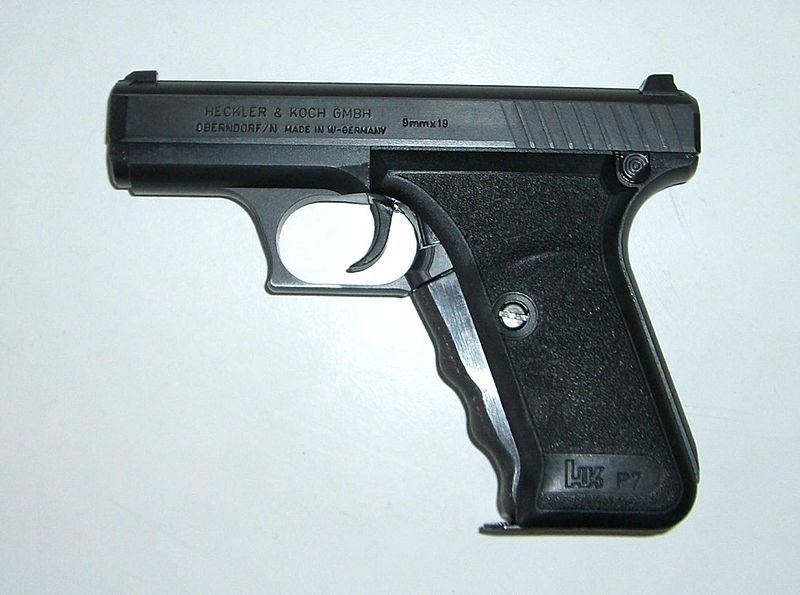
Image from Wikimedia Commons

The P7 PSP is one of several pistols developed in response to a functional specification let by the German state police in the 1970s as they sought to modernize their equipment in the wake of the Munich Massacre.  Several manufacturers produced pistols that met the spec in different ways.  German police organizations were free to choose from the results. Instantly ready with no switches, instantly safe when dropped, totally reliable, and possessing some of the best ergonomics of any pistol every made, the H&K P7 met the sensible specification with a collection of clever design elements.

I took a P7 PSP on my first trip to Jeff Cooper's Gunsite for API-250 Basic Pistol in 1986. I got ribbed for bringing a staple gun to a shooting school. I got ribbed - "Hey, where's the rest of your holster?" - for carrying it in in a very minimal Rogers holster; a hand-signed early laminate job not much larger than a pager, a surprisingly secure speed rig, of which I've never seen another example. The Old Man said, "That's a fine pistol; too bad it's chambered for the wrong cartridge."

The P7 takes much less force to hold at full cock than it does to cock it. Anyone who can't cock a P7 is likely going to have trouble racking a slide or squeezing off a double action trigger. It is not noisy when cocking but it does make a distinct "clack!" when you release the cocker (unless you have the time, presence of mine, and fine motor skills under stress to do the silent decocking trick).

My P7 is utterly reliable. It never once failed to feed, fire, extract, or eject all week, unlike most of the 1911's I've shot or seen shot. During the failure drills rangemaster Louis Awerbuck told me "the P7 doesn't stop, but you need to play along." In my direct experience the only other pistol that comes close to this level of reliability are the various Glocks.

It's fast. I wasn't often the first from the holster, but I was always the first one done. It was Wednesday before I realized I was shooting "hammers" back to 10 meters. The magazine change is faster than it looks as it does not share the usual disadvantages of a heel mounted magazine release. Press the P7's latch and the magazine fairly springs from gun, if you aren't already removing the magazine as your hand sweeps down on the way to your mag pouch. It's sights are fairly coarse which contributes to speed at 25 meters or less. 

I used more ammo than most making the hard set poppers fall over in the outdoor simulators - "Better switch to the head," and shot halfway through the shoot-off (there were only two other minor calibers s in the class). I was looking forward to the .45 ACP version, but the prototypes circulating through various law enforcement agencies at the time did not deliver on the promise. The few shooters I spoke with who got to try the 45 ACP version admired everything about it except it's reliability - seems the 45 ACP pressure curve was all wrong for the gas-retarded action. That's probably for the best as I'd have only "needed" one pistol if there was a P7 .45 ACP in the world.

The PSP had a few flaws. The slide serrations tended to rub a fella's strong hand thumb to the pink. A touch with a fine file can fix that. The squared trigger guard slowed my presentation so I had the Gunsite 'Smithy round it off for me.

The trigger on my P7 is not as nice as that on a 1911 when being used for precise work at a long range. The "sear" feels like it's rolling off its engagement, which combined with PSP's coarse sights, makes deliberate work on the 50 yard line pretty challenging.

The P7 PSP could certainly heat up to the point of discomfort if shot a lot. This is a problem only on the training range. I read one Usenet anecdote of a cartridge "cooking off" in an overheated P7 but have never seen another.

You can't use lead in the P7 or it will gunk up the gas system. Big deal, only junky gun range 9mm ammo comes with lead bullets. At least the P7 won't go "KaBoom!" like a Glock does when fed a steady diet of cheap remanufactured lead bullet ammo. It only eats jacketed ammo of high quality, but who would anyone fight with anything less?

Being all steel, except for its synthetic grip panels, the P7 is heavy for its size.  These days single stack 9mm pistols weigh half as much.  Still, none of them combine as many nifty design elements in one handy gat.

The later P7M8 and M13 were less comfortable in my hand and the sharp little magazine release flippers were not nearly so fast as the heel latch on the PSP. The heat shield on these later models were a nice addition at the range, but even at Gunsite my PSP rarely got so warm I was uncomfortable. The 380/22 convertible was interesting but not that much smaller or lighter than the 9x19 and it was bloody expensive. The P7 M13 "Gordo" and the P7 .40 "Orca" (my nicknames for them, not the factory's) were bulky and abominably top heavy, respectively.

The P7 was a certainly a poor choice for cops transitioning from DA revolvers to self-loading pistols. Many many cops, rangemasters, and administrators learned the hard way that the boys in blue had been drawing their revolvers with their fingers on their triggers all these years.

My experience with the P7 was that that it's manual of arms made it a good choice for the one gun man (or woman) who is inclined to undertake serious professional instruction. Its price put it out of reach of all but the most serious pistolero. The average cop has proven much happier with DAO self-loaders in 9x19 or .40 S&W. Serious special weapons types and other operators seem still to call on a tricked out 1911 in .45 ACP when it comes time for precision in a hurry. Unless the GSG9 is still using their dream gun it seem the time of the P7 has come and gone. 

Still, I guess I like mine.

Monday, June 7, 2010

Blackpowder is not for those in a hurry, or "Hey, where is my ramrod?"

An email account of a trip to the range back in 2002...


So, I went to the range last evening to do an hour's worth of shooting before closing time. Should have picked something other than the .54 caliber flintlock Lyman Great Plains Rifle, but I wanted to shoot it from the bench one of these days, so why not today?

I loaded 90 grains of FFFg Goex blackpowder and topped it with a .530 ball and a 0.010 patch. The first shot was in the black at fifty. Then I hunkered down to concentrate, settling both the forestock and butt on bags. Four shots went into about two inches, a few inches right of point of aim. I ran out of balls, so I switched to a new box.

The short starter required quite a rap to get things started, so I glanced at the new box of balls...these were .535, but I was still using 0.010 patches. No problem, I just use the ball puller to remove it. No ball puller. Aaack! Okay, Plan B calls for seating the ball on the charge and firing it out. The ball won't seat with hand pressure...or two hand pressure...on the rod, so I resort to the Continental method used to seat unpatched, oversize balls in the Jaeger rifles - I drive the rod down the bore with a hammer improvised from one of the short pieces of lumber they leave at the benches with which to assemble shooting rests.

I prime the piece, hunker down, cock the hammer, set the trigger, press...psst! Flash in the pan. Reprime. Repeat. Psst! No problem, I'll use the vent pick (a fancy title for the unlooped paperclip in my shooting box). No vent pick in the shooting box. Thppt! No problem, Plan B calls for making one from local materials. Whittle one from a piece of the shooting bench. Insert it, twist, poke, prod...break the homemade toothpick off in the vent. Aaack Thppt! Plan C would is to find a better material with which to fabricate a pick. The trash brass buckets are sealed with loops of wire. I cut one loose with my folding Seeber folding tool.

I clean the vent. I prime the pan. I hunker down at the bench, but pick another target, as all the abuse this load has received cannot help accuracy. I cock the hammer, set the trigger, touch off the shot. BLAM! Damn, that hurt! What happened? I was wearing the PAST Shield, but could feel where the heel and toe of the hooked buttplate had stabbed at me. The first five shots kicked like a 12 bore trap load, this one felt like the time I shot a .458 Winchester Magnum.

Okay, be calm. Inspect the gun, check for damage. The breech is fine. The barrel is fine. I pick up the gun to look at it more closely. My hand closes on the underrib where the ramrod is normally placed when not in use. Where is my ramrod? Dislodged by the fierce recoil? No. Leaning against or lying next to the bench? No. The most likely scenario whispers to me through the fog of denial. Did I launch my ramrod downrange with the troublesome load? I can offer no other solution, let alone one that accounts for the facts of the case.

I spent the last fifteen minutes of shooting time, and the first fifteen minutes after shooting time, looking for my unfletched, brass tipped shaft. I was grateful no one else was there. I did not find it after multiple grid searches from 0-50 yards, and saw no trace of it from 50-75 yards, either. Had it been wood I might believe it had disintegrated, but this was one of the indestructible synthetic jobs - the sort that might still be serviceable after such treatment.

Perhaps the mower will find it...

More on Critical Thinking, Skeptical Inquiry, and the Scientific Method

I don't have time to read too many blogs regularly, so I listen to several of these organizations' podcasts instead...

Image from Wikimedia Commons

Are We Alone? is a radio show and podcast put on by SETI Institute. The hosts, Molly Bentley and Seth Shostack, are imaginative and relentlessly witty. The program reports on straight science as well as skepticism.

For Good Reason "is the interview program hosted by D.J. Grothe, promoting critical thinking and skepticism about the central beliefs of society. Interviews often focus on the paranormal, pseudoscience and the supernatural."  Until recently Grothe was host of Point of Inquiry.

The Infidel Guy Show is one of the oldest skeptical podcasts on the web. It deals with religion as well as the paranormal and pseudo-science. The production values can be a little rough and more than a few podcast debates have raged out of control of the host.

Minnesota Atheists has a podcast that tends toward the dry side much of the time. They are earnest if pedantic.

Point of Inquiry is the official podcast of the Center for Inquiry that addresses “religion, human values, and the borderlands of science.”

Quackcast is hosted by Mark Crislip, MD, who takes an nearly insane glee in skewering what he refers to as "Supplements, Complementary and Alternative Medicine (SCAM)."

I've just started listening to Rationally Speaking, the official podcast of New York City Skeptics. Hosts Massimo Pigliucci and Julia Galef "explore the borderlands between reason and nonsense."

SGU 5x5 is put on by the same crew that does the Skeptic's Guide to the Universe. This format offers concise five minute talks on a single topic.

Skeptics' Guide to the Universe is a classic put on by the New England Skeptical Society. Neurologist Steven Novella, MD, is also the author of the Neurologica blog.

Also a member of the SGU Rebecca Watson is the founder of Skepchick where she hosts their podcast.

Skeptics with a K is the podcast of the Merseyside Skeptic's Society in the UK. Anti-Vaxers and homeopaths are popular topics.

Skepticality is one of the official podcasts of Skeptic magazine. Hosts Derrick and Swoopy have a nice vibe and their thoughts on outreach and education strikes a different tone than other skeptical podcasts.  Their links page is a nice reference.

At Skeptoid Brian Dunning takes 10-15 minutes to apply critical analysis to a single New Age, medical quackery, UFO sightings, or paranormal topic. Punchy and pithy. His site features transcripts and references for each episode. Good stuff in a fun format.

So, is critical thinking the same as skepticism? How does skepticism differ from cynicism? Are skeptics ever credulous when it comes to pet beliefs? Are there other podcasts I'm missing?  Please let me know...

Sunday, June 6, 2010

Intelligent Design?


One of my favorite examples of the need for critical thinking and the value of skeptical inquiry is the "intelligent design" debate.  There's no shortage of books on the subject of biological evolution and its non-scientific counterpoint.
I'm currently reading The Making of the Fittest: DNA and the Ultimate Forensic Record of Evolution by Sean B. Carroll.  It was a text for our son's freshman biology classe at college this year and I'm glad he brought it home.
Carroll also wrote the excellent, if not quite so accessible, Endless Forms Most Beautiful: The New Science of Evo Devo. 


If you're just looking for some interesting websites to help you understand the players in the Intelligent Design movement check out The Panda's Thumb and TalkOrigins on the science side of the ledger. 


On the Creationist, Creation Science, and Intelligent Design side of the hall have a look at The Discovery Institute's Center for Science and Culture and the ever popular Answers in Genesis.

An American Deer Hunter In Africa, Part I

I wrote An American Deer Hunter In Africa in 1998 after returning from a hunting trip with friends to South Africa.  I'll post it here as I did on Usenet's rec.hunting, as a four part serial...

So, you're headed to Africa to go big game hunting. Good for you. If you're like me and my friends this will be your first African hunting trip. You did the math and discovered that it really is cheaper to hunt for ten days in Africa than it is to go on a guided Elk hunt in the United States. You've booked a hunt with a reputable outfitter recommended to you by someone who has hunted with them. Your preparations are well under way, and prepare you must. Our safari last June was a tremendous learning experience. I learned volumes about what to do and what to bring. I did this, in part, by keeping a detailed journal which now contains an only slightly edited recollection of what I failed to do and neglected to bring. If you have a few minutes I encourage you to learn from our successes, and mistakes.

Part I: The Little Things

Four friends and I went hunting at Bush Africa Safaris in northern South Africa, about 30 kilometers from Ellisras, a town near the border with Botswana. The proprietors, Schalk and Terina van Heerden, offer very comfortable accommodations and delightful cuisine. The bushveld 'thornbush country' has much to offer to the first time American hunter. The terrain itself is easy going, the game is plentiful, the bush is thick, and the shots will be quick and at short range. My experience is limited to the bushveld, so you'll need to make some allowances for my perspective as you prepare for different terrain and other countries. That said, let's prepare, shall we.

Do you have a passport? No? Then you'll need to apply for it right away, won't you? Those of you who answered 'Yes,' where is your passport? Are you sure? Why don't you go check right now. Go.

Have a clear idea about what you want to hunt. Get a field guide that describes the animals you intend to pursue. Find one that offers photographs of adult males and females, as well as juveniles. The Stewart's Field Guide: Mammals of Southern Africa is the best I've seen. Study your outfitter's brochures. One can hunt all sorts of animals in Africa, but your outfitter's concessions may not be home to the species you seek. And study the price lists. While hunting in Africa is a bargain, your budget may not accommodate your wildest fantasies. Understand the terrain you will be hunting in. If your ambition is to take Kudu on the ground in its natural mountainous habitat, you'll have to work for it.

Unless you're already fit, get in shape. Hunting is hard work. You'll be creeping through the bush all day. You'll be jumping in and out of bakjes. You may get to help drag your Zebra into the truck. At the peak of any of these exertions you may be presented with a challenging shot at a really nice trophy animal. You'll do better if you're not winded. At a least start doing sit-ups and push-ups --the slow, difficult kind-- every evening. Better, you could pursue an exercise plan that increases your aerobic capacity. Running, bicycling, swimming, even walking, will do. Anything is better than nothing, unless you wait till the week before your trip and hurt yourself with overexertion.

If you have any physical malady, treat it long before you leave, and then bring emergency treatment along in case it recurs. I had an emergency root canal the day before leaving for Africa, and then popped the top of the temporary filling in the departure lounge at the airport. Better to have had the crown completed before I left. Fortunately for me the bottom half of the filling held for two weeks. I had antibiotics and painkillers with me, which would likely have held me over until I could find a dentist in surprisingly civilized South Africa. Finding a dentist, or other physician, in, or en route to, central Africa might be a real good trick. Oh yeah, if you have any temporary dental work skip the bagels at the airport snack bar.

Get your shots. Take your prophylaxsis on time, every time. As for malaria preventatives I think that the side effects of Larium (mefloquine) almost outweigh the benefit, but then I've never had Malaria. One of our South African hosts had recently been told of a fellow who took ill with 'his malaria' one day and was dead the next. I'm sure there is more to that story, but do talk to your tropical/travel doctor before --well before-- leaving for Africa. Ask her about the newer daily therapies to see if they might work better for you. Visiting the Travel Clinic is one of those things you shouldn't leave until the last minute. Some of your preventative therapies need to be started the week before you go. Oh, I'm sure the clinic will fit you the day before you leave (between your emergency appointments with the dentist and the endodontist) if they can. What if they can't?

Bring your allergy medications with you. I interrupted a really fun stalk with a coughing fit when dust aggravated my allergies. About fifty steps after I recovered, my patient tracker, Filamon, showed me the tracks of a large Kudu bull that seems to have suddenly turned and run away. If you have a cough, I find that sucking on a hard sweet will keep the throat from drying out. Just let it dissolve though; crunching on it will earn you cross looks from your tracker.

If you tend toward dyspepsia, take a Maalox or something. I apparently have one stomach growl that sounds like Blue Wildebeest, and another that sounds like an unhappy Leopard. One sound results in much more excitement than the other when checking a leopard bait site.